



Dr. Kenney’s Friday 5 Spot
On Fridays, I like to share experiences from my week—both with patients and in my personal life—that have left a meaningful impact. My hope is that these reflections offer you something of value, a bit of insight or encouragement that resonates with your own journey and inspires you in some way.
A mindset I embrace. Something I’ve always loved came from the late college football coach Mike Leach, who often said, “Find your inner pirate” and “Swing your sword.” Beneath the humor and eccentricity was a solid reminder about how we should approach life. To me, the “inner pirate” represents boldness, courage, and the willingness to act decisively when opportunities or setbacks arise. Too often, people hold back out of fear, overthinking, or concern about failure. But growth, leadership, and achievement usually require us to step forward with confidence rather than hesitation.
“Swing your sword” is the companion lesson to that mindset. None of us possess every advantage, talent, or opportunity, but every person has something valuable they can bring to the table. The important thing is to use it. Whether it’s your work ethic, kindness, creativity, leadership, or resilience, the world rewards those who are willing to apply their strengths with purpose and conviction. Waiting for perfect circumstances or complete certainty only leads to missed opportunities. Life moves quickly, and those who make the greatest impact are usually the ones willing to trust themselves, take action, and fully utilize the abilities they’ve been given.
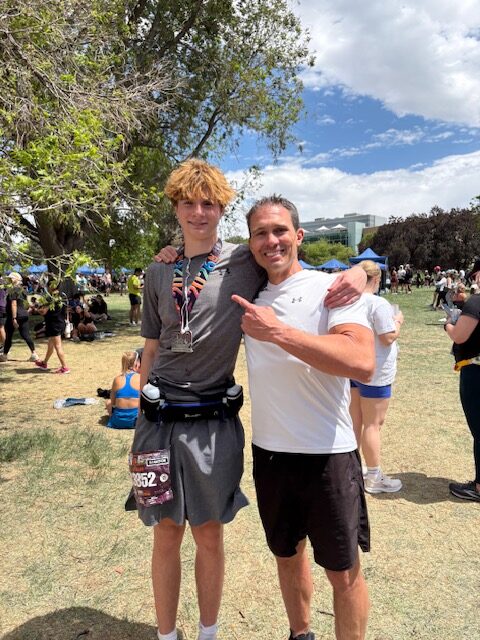
An important concept. On Sunday, my 16-year-old son completed the Colfax Marathon. It was his first race since a 5K since when he was very young, and he did incredibly well. While we were waiting for him to finish, my oldest son made a comment that immediately stayed with me. He said, “I’m excited for him to remember this and know he can overcome hard things, because it made a huge difference in my life.” That statement perfectly captured something I deeply believe: difficult experiences, when willingly embraced, can permanently change how we see ourselves.
My oldest son understood this because at just thirteen years old, he ran 33 miles with me during one of my endurance races. Since then, he’s told me countless times that whenever he feels overwhelmed, exhausted, or uncertain, he reflects back to that experience as proof of what he’s capable of. I’ve found the same thing to be true in my own life. When we intentionally challenge ourselves physically, mentally, emotionally, or spiritually we build a reservoir of confidence and resilience that we can draw from later. Adversity, when approached the right way, teaches us that we are stronger than we think. Those lessons don’t just help us during the challenge itself; they become anchors we can rely on for the rest of our lives.
An important question. As my son ran his marathon Sunday, I would text him short pieces of motivation or encouragement. He was probably 16-18 miles in when I texted him, “Who are you when the pain starts?” In other words, when things are taking a turn for the worse, you are physically hurting, and mentally fatigued; how will you handle it? This is an important question for us all to ponder and the answer is even more crucial.
In my experience, when pain or challenges begin, people seek either stories or action. The story option involves creating justifications and excuses for poor results. These might include perceived bad breaks, unfair circumstances, lack of resources, fatigue, or any number of other examples. Action on the other hand is far different. This is a decision to keep moving forward, problem-solving, and remaining steadfast in the end goal. Furthermore, it is acceptance that being in pain is simply part of the success equation. Who you become when the pain starts is a key to life and I recommend always seeking action rather than stories.
An analogy I like. If you spend any time around fitness, you’ve probably heard the phrase, “Don’t skip leg day.” There’s a reason it gets repeated so often. Training legs is usually harder, more exhausting, and less glamorous than focusing on the upper body. Because of that, many people (especially men) avoid it in favor of exercises that are easier or provide quicker visible gratification. The problem is that over time, neglecting an important area creates imbalance. You may look strong in one aspect, but weaknesses eventually become obvious. I think this idea applies to far more than fitness and is a great analogy for life itself.
Life requires us to develop in areas that are not always enjoyable or exciting. Discipline, difficult conversations, financial responsibility, patience, consistency, and self-control are never as immediately rewarding as comfort or entertainment. Yet these “leg day” aspects of life are often what create the strongest foundation for long-term success. If we focus solely on what feels good in the moment while neglecting areas that require effort and growth, imbalance eventually appears in our relationships, health, work, and character. Becoming the best version of ourselves means being willing to address the hard things, not avoid them. Growth isn’t built as much on what we enjoy as it is the challenges we consistently choose not to skip.
Some quotes I Love.
“Every man, at some point in his life, is going to lose a battle. He’s going to fight and he’s going to lose. But what makes him a man is that in the midst of that battle, he does not lose himself.” – Coach Taylor, Friday Night Lights
“If a snake bites you, you don’t chase it for answers or try to prove you didn’t deserve it. You move toward safety, you heal, and you keep going. The same applies to people.”